Event filtering
On-Call Optimizer collects as little calendar data as possible.
Calendar data is sensitive and often contains personal details. On-Call Optimizer filters and matches events, and stores only the details it needs.
Initial filters
- On-Call Optimizer only requests event details for those calendars which have been specifically enabled.
- Event details on other calendars will not be read or accessed by On-Call Optimizer even if access to them is incidentally available.
- When processing events on configured calendars On-Call Optimizer filters events using the following set of criteria
- The event must be organized, or accepted by a trusted address as described below, AND
- The event must not have ended, and must start within the next 90 days. If one of your schedules assigns shifts further ahead than that, the limit is extended to cover it.
Any event not matching both criteria is ignored and not processed further. On-Call Optimizer does not store any details of these events.
Event ownership and acceptance
Only events that are either organized or explicitly accepted by a trusted address are processed as sources of availability information.
Events created by other users which appear on a calendar (e.g. because you have been invited to participate in the event), will be ignored by On-Call Optimizer until accepted by a trusted address. This check is in place to prevent any user with the ability to create invitations on your calendar from being able to create availability information for you.
Trusted addresses
The default trusted addresses are:
- Your On-Call Optimizer account email.
- The email of the Google or Microsoft account used for a calendar connection (only trusted on calendars from that connection).
- The calendar itself, so events a shared calendar organizes on its own are trusted on that calendar.
In a calendar feed, an event with no organizer is treated as organized by you.
Adding a new trusted address
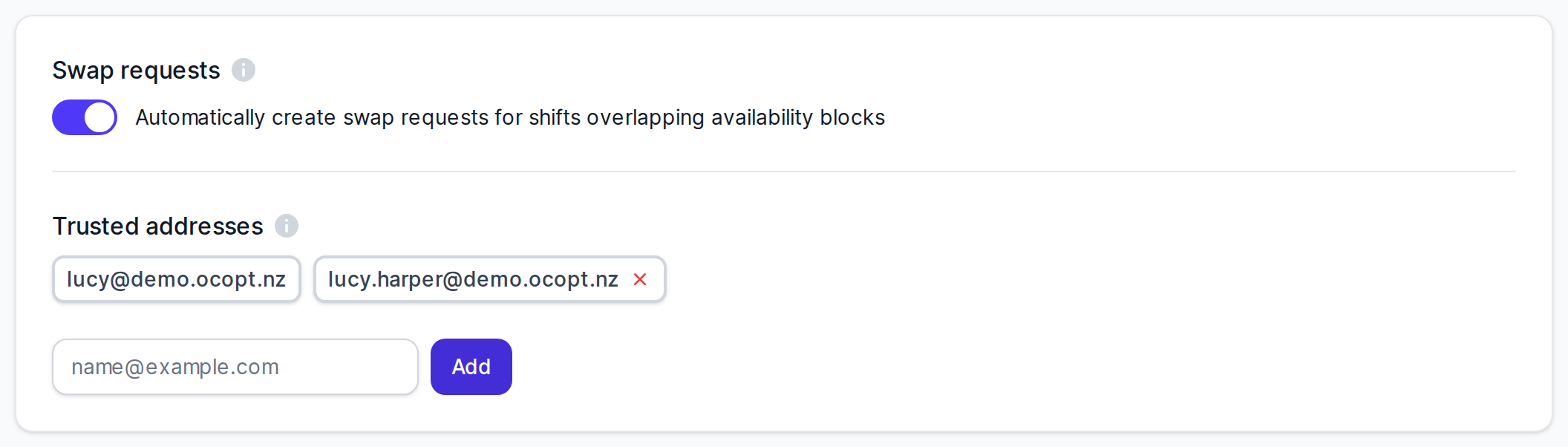
You can add up to 10 additional trusted addresses on the Calendars page (click your avatar at the top right of the application and choose Calendars). The Trusted addresses panel is in the card at the bottom of the page.
- Enter the address to add in the box provided.
- Click the Add button on the right of the input box.
Removing a trusted address
- To remove an address you added, click its chip in the Trusted addresses panel (the chip shows a red X icon). The address is removed straight away.
- You cannot remove any of the default trusted addresses described above.
- Trusted addresses scoped to a single connection are shown with a link (chain) icon instead of the X icon. Hover over the chip to see which connection it applies to.
Event matching
Events passing the initial filter are only imported when either:
- The event type indicates the event represents unavailability, OR
- The title or description contains one of the recognized tags.
Refer to the availability information documentation for further details on how the matching process works.
Imported data
Calendar events which make it through the filtering and matching process are imported into On-Call Optimizer’s database.
Imported events are stored as 4 pieces of information:
- The member to whom it relates.
- The start time.
- The end time.
- An action (prefer, or block).
On-Call Optimizer does not store any of the textual details of the event (e.g. the title or description), nor any information about the invitees or participants.
On-Call Optimizer does not store any details of events on calendars not selected for import, or which did not pass the filter or matching stages.